Linden flower/lime Tilia Europea
Family: Malvaceae (Mallow)
Names/folk names: Tilia Vulgaris, Tilia Intemedia, Tilia Cordata, Tilia Platyphylla, Linden Flower, Lime blossom, little-leafed Lime, Common Lime, Flores Tiliae, Tilleul.
Appearance & habitat: The Linden (Lime) tree can grow up to 130 feet tall and has smooth grey trunks and glossy twigs. The leaves are heart-shaped, pointed leaves, around 6 – 10cm long with a sharp toothed edge. Leaves are a lime green colour when new and turn a darker evergreen colour later on in the year. In summer, the tree produces small, cream – white flowers in pendulous clusters with yellow – orange stamens. The flowers give off a strong, beautiful scent and are high in nectar, making them very popular with bees. Once they have finished flowering, the flowers turn into ball shaped capsules. Lindens can be found in well drained, moist soil and are usually found in parkland, typically planted in avenues. There are thought to be 20 to 45 species in Europe, Asia and North America.
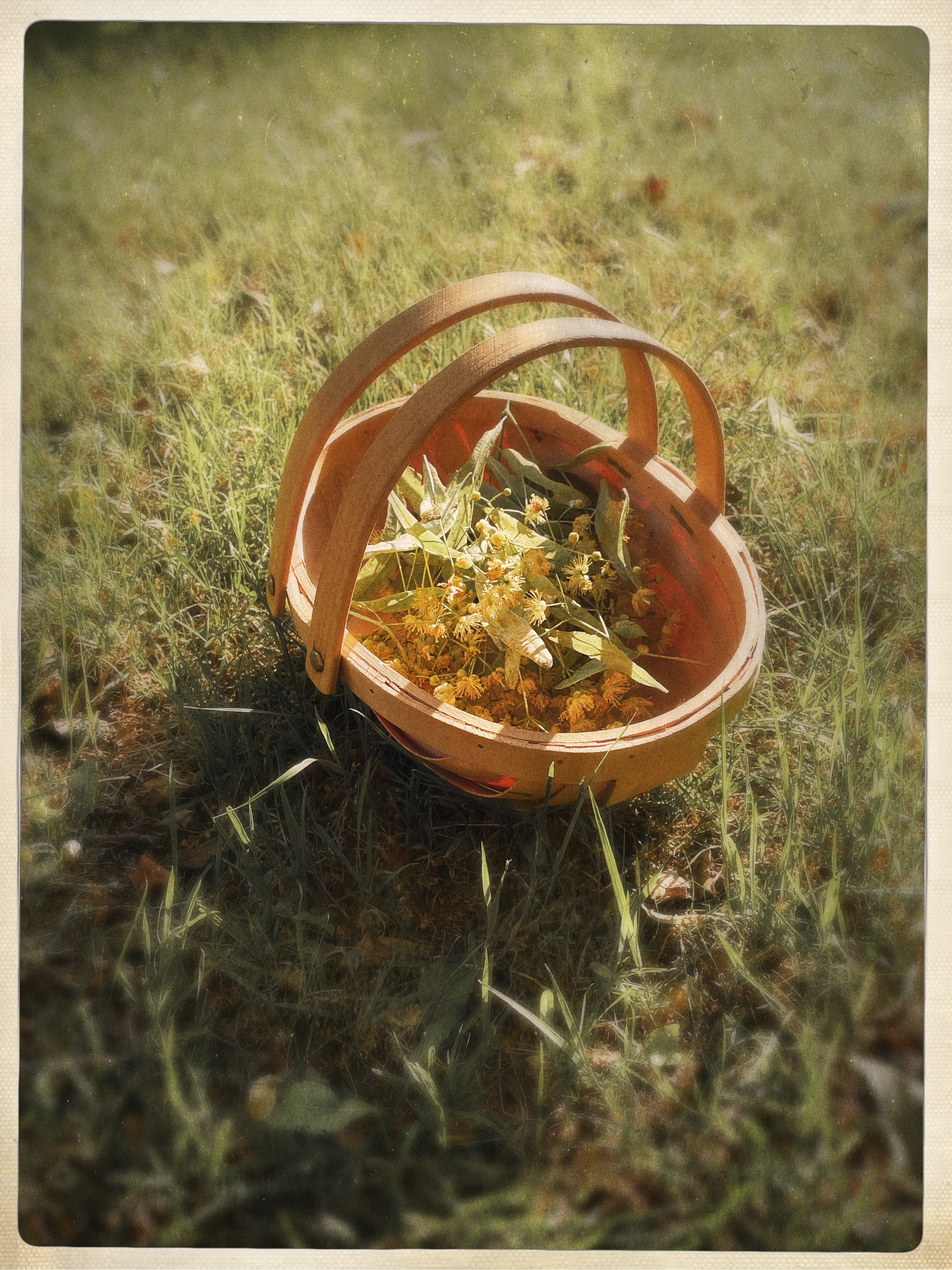
Parts used: The flowers can be used as a herbal tea when they have just bloomed. The flowers develop narcotic properties with age, so you must harvest when the buds begin to open and before the seed capsule has been formed. The leaves and buds will be covered in a sticky substance later in the season, which is aphid excrement.
The young leaves can be used in early Spring and substituted for lettuce in salads or used in the same way as a vine leaf.
Culinary uses: Dry the flower out of direct sunlight to make Linden tea. Linden flowers should only be left for 3—4 minutes to steep, as the flavour is delicate flavour will be lost. Linden tea is particularly popular in mainland Europe. You can usually find Linden sold as a herbal tea in Eastern European stores in the UK.
Plant Folklore: The Linden tree was considered to be sacred in many cultures.
♠ In Ancient Greek mythology, Philyra the nymph was raped by Saturn disguised as a horse. Philyra gave birth to Cheiron the centaur and was revulsed with the outcome, so she begged the God’s for help, which resulted in her being turned into a Linden tree. The virtues of the Linden tree is mentioned by Pliny, Virgil, Horace and Homer. In Ovid’s fable of Baucis and Philemon, upon both of their deaths, one was changed into a Linden tree and one into an oak tree intertwining each other.
♠ In Scandinavia and Germanic cultures, the Linden tree was dedicated to the Norse goddess, Freya and was used as a wedding tree.
♠ In Baltic folklore, women would make offerings to their goddess Laima by making offerings to Linden trees in return for wealth and fertility.
♠ In German folklore, the Linden tree is termed, the “tree of lovers.” The medieval poem written by Walter von der Vogelweide in around 1200AD, “Under der linden” depicts a rendezvous between a knight and a lady maid beneath a Linden tree. Sitting beneath a Linden tree was thought to cure epilepsy in folklore.
♠ The herbalist, John Gerald’s cited the following in his herbal, published in 1597, “The floures are commended by divers (various people) against paine of the head…against dissenesse, the Apoplexie (stroke), and also the falling sicknesse (epilepsy)”.
♠ Place names in the UK that start with “Lin” or “Lind” have been named with Lime in mind and would have meant there were lots of the trees in the area. These names include Lyndhurst, Lincoln.
Medicinal properties and uses
♠ The flowers contain flavonoids, tannins, mucilage and volatile oils, and have soothing, sedative and expectorant effects. This means lime is beneficial for circulatory system and strengthens blood vessels, whilst lowering the blood pressure.
♠ Linden flower is used to increase perspiration, so is helpful when used at the start of a cold, flu, virus or fever, as it helps to cool the body if you have a fever. This can be taken in the form of tea, liquid extract or as a tincture, and can be combined with Anise and Thyme to help with dry coughs and catarrh.
♠ Linden is an excellent tea for people who suffer from insomnia and nervous disorders.
♠ Linden is useful for leg cramping as it has an antispasmodic effect on the body.
The astringent properties of Linden can used as a poultice, where lime leaves can be helpful to treat sprains, wounds and swellings.

 Louisa Jane Auston